
Present, But Not Findable

Part 1 published on March 1, 2026.
After an hour of focused skimming through the Cincinnati Court Index, I finally came across the case I was looking for.

The Court Index is organized by date. On the first page, there’s a broad overview of what moved through the court—everything from property resolutions to what I’m investigating: first-degree murder. I started there, hopeful that the main page for the day would give me something, anything that pointed to the case. But it didn’t. There was nothing that even hinted at it.
Maybe this is my naivety, but I assumed a first-degree murder case shaped by race—by who was allowed to be seen as belonging—would leave a louder footprint. But I was wrong.
So, I shifted to the section that lists the day’s cases by judge and room. Logically, I figured I needed to find the judge’s name and then track the corresponding room. Judge Schneider was in Room 6. Simple enough.
But that’s where the search turned strange.
I tracked the rooms in order. I saw Room 5 and felt my excitement rise—like I was getting close. Then the next listing was Room 7. Perplexed that there wasn’t a Room 6—a gap.
I paused, trying to make sense of it. Why was Room 6 omitted? Was the docket moved? Was the case reassigned? I jumped ahead to February 28th, 29th, and then March 2nd to see if the case surfaced after a shift. Nothing. I searched backward through February 20th. Still nothing.
And even though I had evidence the case existed, it kept slipping out of view—the goal post was moved. He was present, but not findable in the way I expected it to be.
At that moment, an old Enquirer article came to mind—something about the case moving to another courtroom, maybe even another wing. I pivoted and searched the Cincinnati Public Library’s newspaper archive to find it. I tracked the article, and near the end of the article, the writer mentioned that a judge had been moved to the new Federal Building, and the former courtroom became the new criminal courtroom.

I went back to the Court Index and pulled up the calendar for the day under that judge. That’s when the fog lifted. Judge Schneider had been moved to Room 2, and the only case on his docket was the one I was looking for.
Jolted with joy, I read the entry slowly. The details lined up. The names matched what the newspapers reported. The story finally held still long enough for me to touch it. And then I saw what wasn’t there: no case number.
This pattern of missing information points to a lack of care—care in the moment of documentation, and care in what was preserved afterward. Just when the record gives you enough to believe you’re close, it withholds the one thing you need to go further. It’s like being handed a map with the street names scratched off: you can see the shape of where you’re trying to go, but you can’t quite arrive.
It doesn’t feel random. It feels patterned. It feels like the system did its job for the people it was built to serve and did the bare minimum for everyone else. When the lives being recorded are already treated as marginal—foreign, disposable, outside the circle of belonging—the paperwork becomes thin. Details become optional. Precision becomes selective.

I walked over to Amy—who first helped me with my request—and told her I found the court listing, but there wasn’t a case number. How am I supposed to request the documents without a case number? She looked at the page, and for a moment, she was as confused as I was. We stared at it together, trying to make sense of a record that was simultaneously precise and incomplete.
She said she would reach out to the records department to figure out how I could make the request. A few minutes later, she returned and told me the person I needed to speak with wouldn’t be available until three o’clock. If I could wait, she said, we could talk with him then.
God works in mysterious ways, because before three o’clock had even arrived, Jason Alexander walked into the library. Amy spotted him, practically flagged him down, and said, “You’re the person we’re looking for.” She introduced us, and we laid out the dilemma—proof the case existed, but no case number to anchor the request.
He didn’t hesitate. He told me the only place that missing information would live was on microfiche, and that he would have to run a name search through the index. He handed me his card.
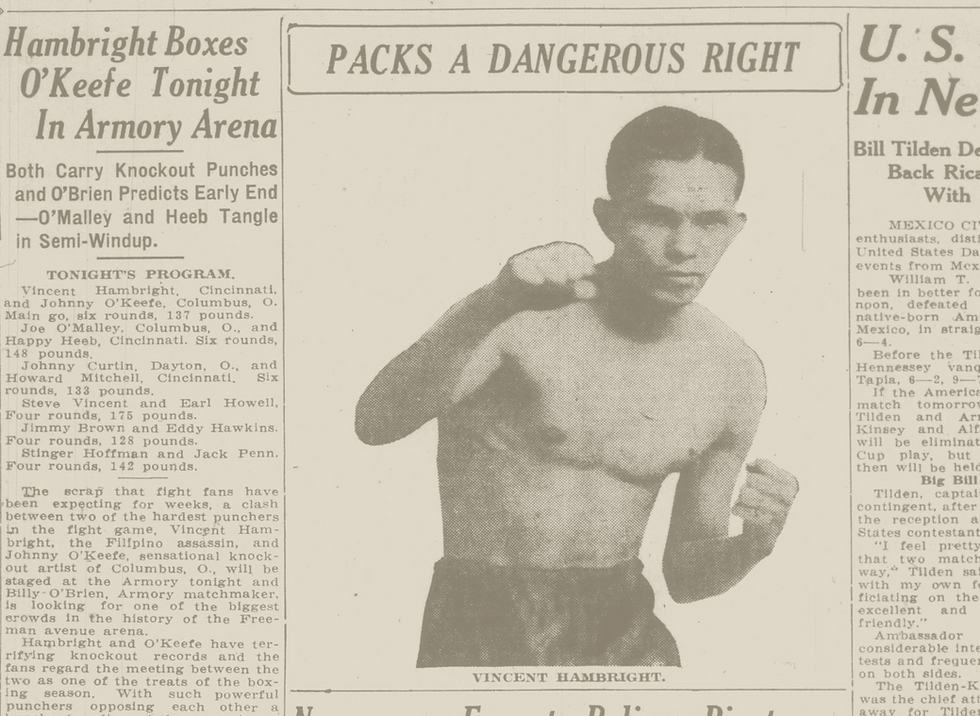
I left with a small pulse of optimism—something to hold onto—but it didn’t take long for that familiar deflation to creep in. I’ve been here before. With Vincent Hambright, I learned how hope can flare up in the presence of a lead and then dim just as quickly when the record refuses to open.
And that’s why community archiving matters. It’s why we have to tell stories alongside the archive—not to invent, but to complete what institutional memory couldn’t or wouldn’t hold. These silences haunt how Asian Americans are understood in Cincinnati. Our story is still incomplete, and it’s on us to make sure it becomes part of the historical narrative.


Comments