
Historic Buildings: Connecting Generations through Shared Spaces

Historic buildings are often treated as static landmarks. This essay explores how memory, storytelling, and shared authority transform them into living sites of meaning—particularly for APIA histories in Cincinnati.
Cincinnati, Ohio, is renowned for its abundance of Italianate architecture. The city’s skyline is defined by the bracketed cornice rooflines that stretch across entire neighborhoods. The style flourished in neighborhoods such as Over-the-Rhine, Lower Price Hill, the West End, the Central Business District, and Mt. Auburn from the 1850s to the late nineteenth century. A notable section of the West End, Dayton Street, was registered as a historic district in 1973. Once referred to as Millionaire Row, the street highlights the city’s most extravagant examples of Italianate architecture, housing some of Cincinnati’s wealthiest and most powerful residents. These homes are not merely architectural achievements; they are containers of a rich tapestry of experiences, bearing witness to the accumulated memories of the people who lived, worked, and gathered within these grand structures.

The essence of buildings of the past extends beyond their physical materials—wood, brick, nails, tile, and glass. It is embedded in the spaces that carry human memory, preserving the narratives of those who shaped, inhabited, and sustained them—whether formally recorded or historically ignored.
There are many untold stories from the Asian and Pacific Islander American (APIA) communities in Cincinnati, whose voices remain underrepresented in the city’s dominant historical narrative. Early spaces such as Chinese laundries and cultural tea
houses—though often small or transient—were integral to the community’s social and economic landscape and stand as silent witnesses to the resilience and determination of generations who contributed to Cincinnati’s diverse economic and social fabric.
The façade of a building offers a window into its past, but it rarely reveals the living context—the ephemeral, everyday moments—that once filled its interior spaces. Architectural details—the picturesque, bracketed cornice, crowned window pediments, and beveled corners—remain silent about the lives, celebrations, labor, and struggles that unfolded within the walls. Without shared memory or interpretation, these stories remain buried in brick and mortar rather than carried forward. For the APIA community in Cincinnati, the long-standing marginalization of their histories has made exclusion from the larger narrative both common and normalized. Recovering these narratives requires intention: human inquiry through archival research, oral histories, and community engagement that together piece a fuller understanding of place.

Sharing the stories of our ancestors weaves the past into the present, transforming memory from narration into practice. Once memory is crystallized, buildings shift from static landmarks to active sites of meaning. Through storytelling, historic spaces become vessels for collective memory, carrying significance that extends beyond their physical form.
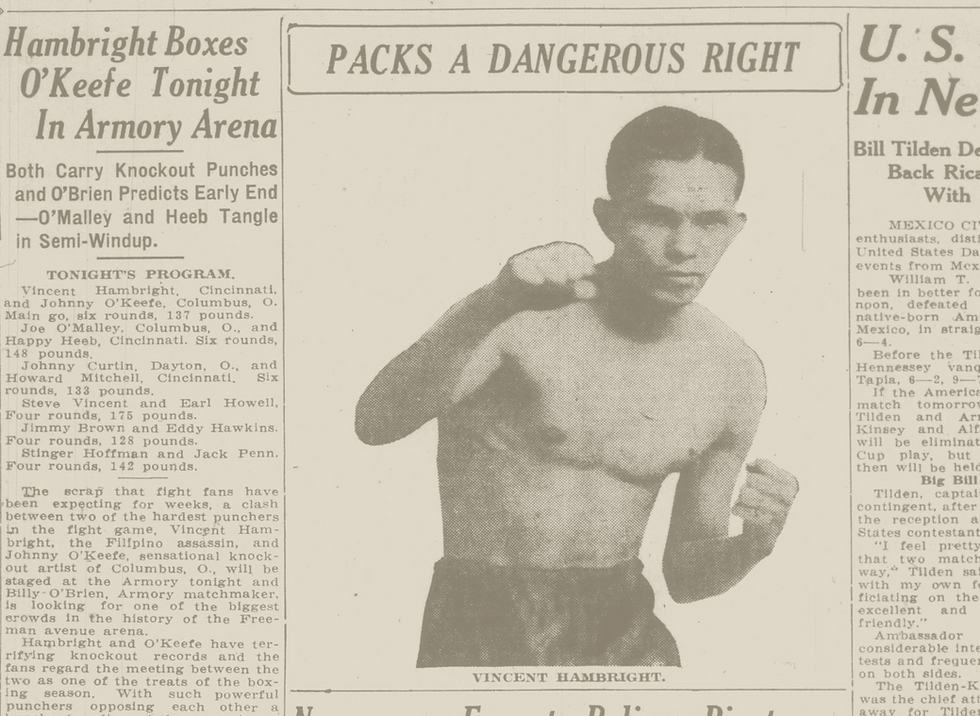
Moments such as the roaring crowds that filled the Victorian Gothic walls of Music Hall in the 1930s—cheering as Vincent Hambright, the first Filipino American boxer in Cincinnati, knocked out his opponent—illustrate how lived experience animates historic space, not only through the recall of an event, but through the ways its meaning endures in shared practices. In this way, stories do more than connect people to architecture; they invite the public to participate in co-creating history as a shared, evolving responsibility. Through storytelling, neighborhoods become interconnected not just by geography, but by memory.

A building’s interior is connected to the lives and spirits of its inhabitants, linking generations through shared space and experience. Historic preservation allows the public to sustain these physical environments, where multiple layers of memory coexist, bridging past and present. These sites function as what I call Time stations, holding ephemeral moments—childhood joys, community rituals, and everyday labor—within enduring architectural forms. In doing so, preservation transforms fleeting experience into collective memory, allowing heritage to move beyond nostalgia and into historical understanding.
As many historic APIA spaces no longer exist, community storytelling offers a way to create an archive rooted in lived experience. Without this move toward shared authority, APIA history will continue to be overlooked. As a result, preserving structures alone is not enough; preservation must also encompass the stories, relationships, and lived experiences these buildings once housed. Only then can Cincinnati’s history be told with accuracy and integrity. When stories emerge beyond the physical structure, buildings gain depth, breadth, and meaning—becoming lasting testaments to the lives that once animated them.


Comments